
The Kitchen Table Matters: What New Research Tells Us About Learning at Home
Two pieces of research caught my attention recently.
The first came from the National Literacy Trust's 2026 research into children and young people's reading. There was some good news: after several years of decline, reading enjoyment rose slightly this year. But the bigger picture remains worrying. Just 36.1% of 8–18-year-olds say they enjoy reading in their free time, and only 20.3% say they read daily.
Perhaps most strikingly, the disadvantage gap in reading enjoyment more than doubled in the past year. Children receiving free school meals remain less likely to enjoy reading than their peers.
Then came another National Literacy Trust study, this time looking at what happens at home with children aged five and under.
And one finding might surprise you: Parents in the highest-income households were not the most likely to read with their children every day. That matters, because it points to something bigger than income alone.
Learning at home isn't simply about having more
We often talk about educational inequality in terms of access: access to books, resources, tutoring, clubs and opportunities. And of course, access matters enormously.
But the National Literacy Trust's research into 3,194 parents and carers also highlights the very ordinary pressures affecting family life. Lack of time because of working patterns was the most commonly reported barrier to shared learning activities, cited by 38.4% of parents. Cost and stress were significant barriers too.
It made me think about how easy it is for us, as parents, to assume that supporting learning at home needs to be another thing. Another activity to organise. Another club to drive to. Another workbook to complete. Another item on the list.
Perhaps it doesn't.
Small things, done often
Some of the most valuable learning at home can happen in tiny moments:
- Reading a chapter together before bed.
- Wondering aloud what an unfamiliar word means.
- Trying to work out a number pattern.
- Doing the crossword at the kitchen table.
- Arguing over the answer to a riddle.
- Playing a word game in the car.
As a teacher, I've always been interested in what happens when children encounter ideas and skills repeatedly. Vocabulary grows because words are met again and again. Number fluency develops through regular practice. Reasoning becomes easier when children have lots of opportunities to stop, think, try something and occasionally get it wrong. None of that needs to look particularly like school. In fact, sometimes it's better when it doesn't.
Enjoyment matters
There's another important message in the reading research.
Children who enjoy reading tend to read more often. The National Literacy Trust also found that children themselves recognise the benefits of reading for learning, wellbeing and understanding the world around them.
That idea — enjoyment first — feels important beyond reading too.
If we want children to become curious thinkers, confident problem-solvers and enthusiastic learners, perhaps we need to give them more opportunities to experience thinking as something enjoyable. Not a test. Not homework. Not something they are doing because an adult has told them they should.
Just something interesting sitting in front of them.
Why the kitchen table matters
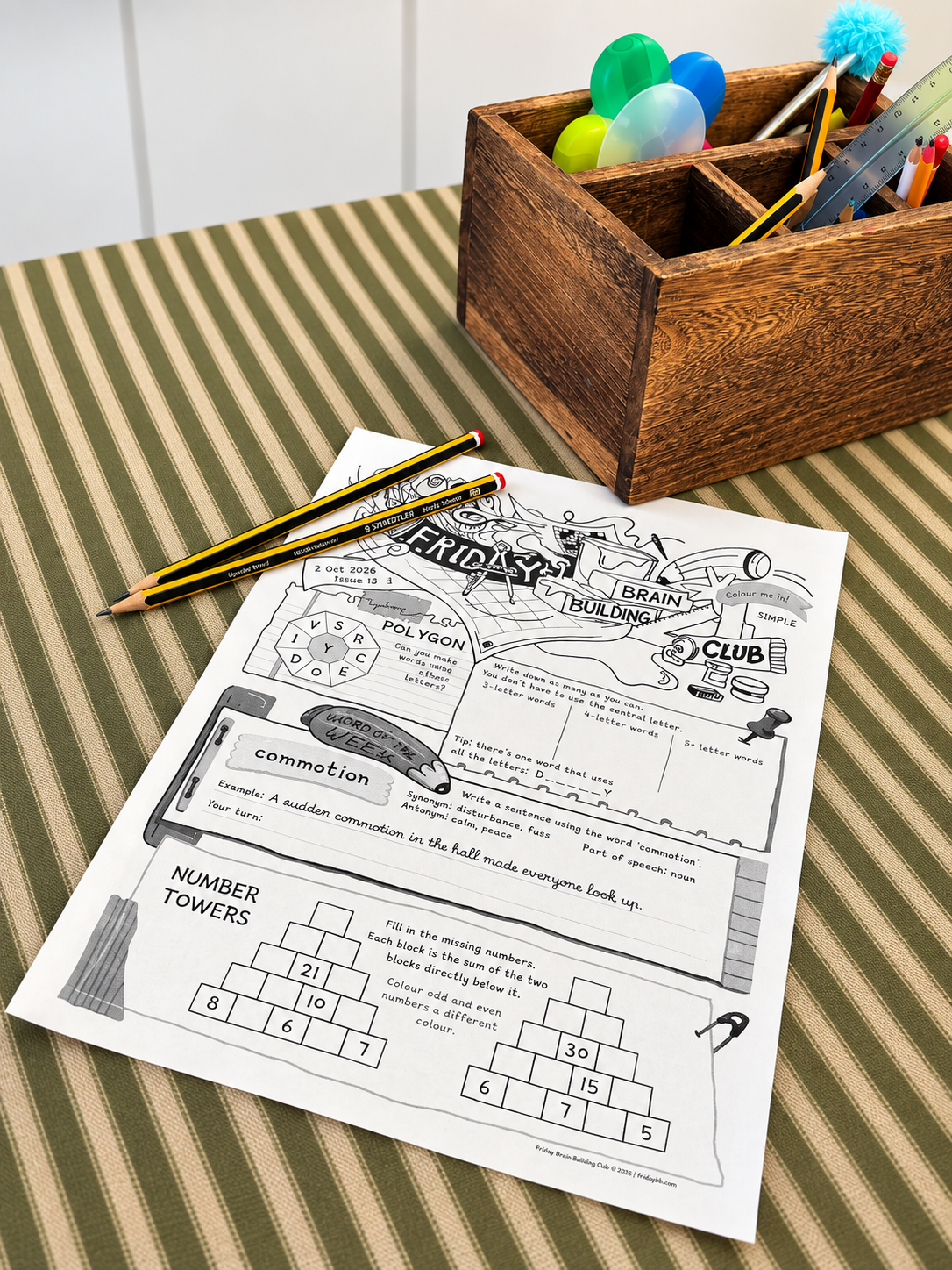
This is one of the reasons I started Friday Brain Building Club. I wanted something I could leave on the kitchen table for my own children: a crossword, a number challenge, an interesting new word, a logic puzzle or something they couldn't immediately work out.
No screen. No big announcement that we're doing learning now. Just an invitation to have a go. And increasingly, I think the simplicity of that matters. Families are busy. Parents are busy. Children are busy. Supporting children's learning shouldn't always require us to find another hour in the week. Sometimes it might simply mean putting something interesting in their path.
And every child should have those opportunities
Of course, we also know that those opportunities aren't distributed equally. The widening disadvantage gap in reading enjoyment is a reminder that access still matters hugely. That's why the community side of Friday Brain Building Club is so important to me. Alongside keeping the subscription deliberately affordable, we're working to get our Brain Building Sheets into the hands of children who might not otherwise receive them, including through schools, hospitals and community organisations.
We also support the National Literacy Trust and its work to improve literacy and give more children the opportunities they need to thrive. Because whether it's a book, a crossword, a number puzzle or a brilliant question that starts a ten-minute conversation, every child deserves opportunities to be curious. And sometimes, those opportunities can start with something as simple as what we leave on the kitchen table.
Bring a little brain building to your kitchen table
Every Friday, Friday Brain Building Club delivers a new screen-free activity sheet for children aged 7–11, packed with vocabulary, numeracy, verbal reasoning, logic and problem-solving challenges.
Try Friday Brain Building Club free for 30 days, then £4.99 per month. Cancel anytime.