
How to Build Your Child's Vocabulary Without Learning Word Lists
A strong vocabulary gives children far more than an impressive collection of words.
The words children know help them understand what they read, express what they think and make sense of new ideas. Vocabulary supports learning across the curriculum because language is one of the main tools through which children encounter new knowledge.
But building vocabulary doesn't have to mean sitting down with a long list of words and definitions.
In fact, some of the best vocabulary-building happens almost unnoticed.
Notice interesting words
Start simply by becoming a family that notices words.
You might encounter reluctant in a story, fragile on a parcel or astonishing in a newspaper headline.
Pause for a moment.
What does it mean? Is there another word that means something similar? What's its opposite? Could your child use it in a sentence?
You don't need to turn every unfamiliar word into a lesson. Doing that could rather quickly take the pleasure out of reading! But choosing one interesting word occasionally and talking about it can make children more attentive to language.
Meet words more than once
Hearing a word once doesn't necessarily mean a child will remember or confidently use it.
Words become more familiar when we encounter them repeatedly and in different contexts.
If you've discussed the word reluctant, for example, look out for opportunities to use it naturally later.
Perhaps someone is reluctant to get out of bed on Monday morning. The dog might be reluctant to go outside in the rain. A character in a book might reluctantly agree to something.
Suddenly an abstract definition has become a useful word.
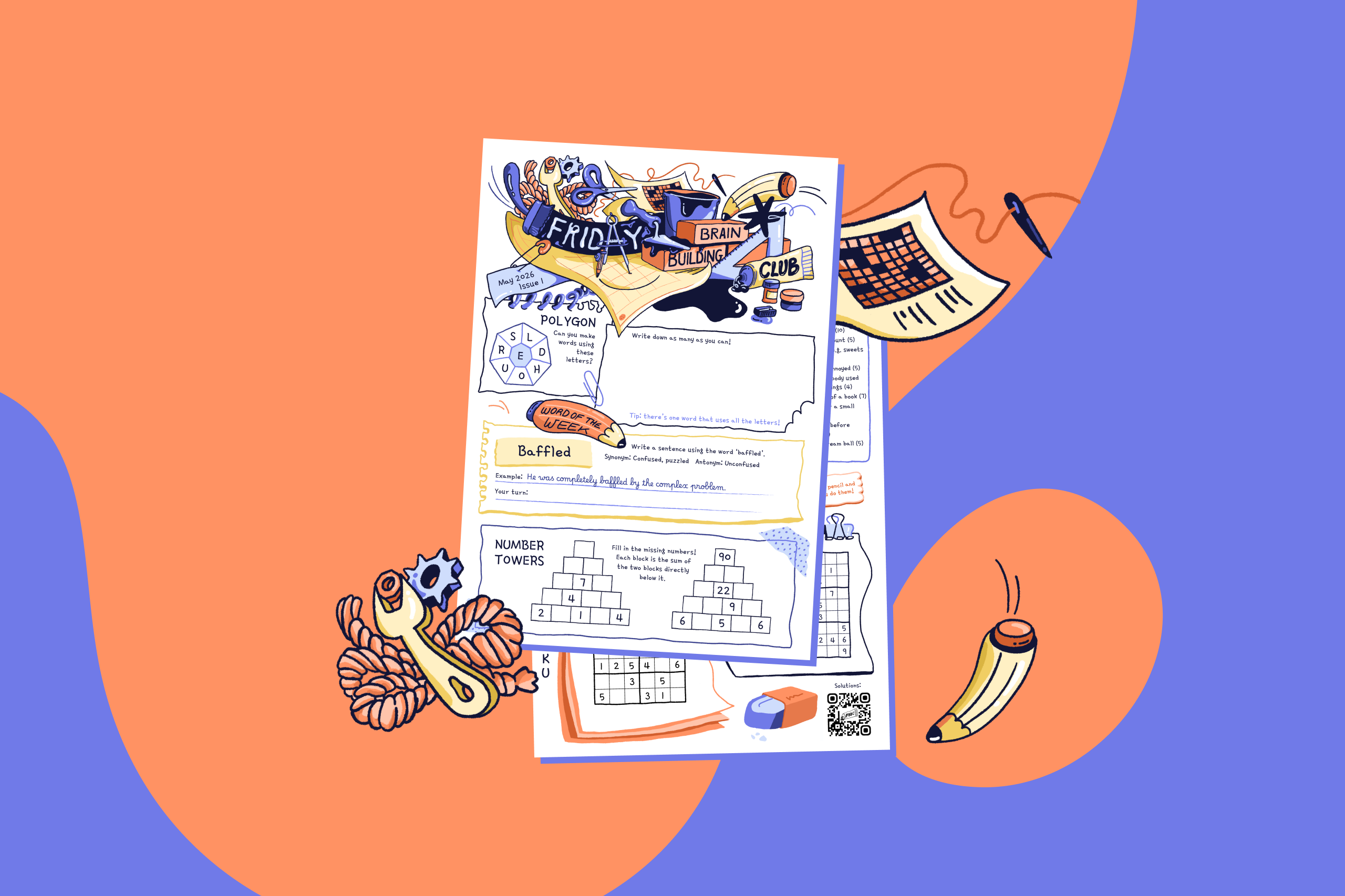
This is one reason every Friday Brain Building Club sheet contains a Word of the Week. We introduce the word with meaning and context and encourage children to use it themselves.
Read widely
Books expose children to vocabulary they may not encounter in everyday conversation.
But “reading widely” doesn't have to mean working through a prescribed list of worthy novels.
Stories, non-fiction, comics, children's newspapers, poetry, biographies, fact books and magazines all introduce different kinds of language and knowledge.
A child reading about space will encounter one set of words. A mystery story will introduce another. A recipe, football report or book about Ancient Egypt offers something different again.
All of those encounters add to the store of language and knowledge children can draw upon later.
Play with words
Vocabulary development can also be playful.
Think about synonyms while you're walking to school. Can you find five alternatives to big?
Try an odd-one-out: tiny, enormous, miniature, little. Which word doesn't belong, and why?
Play with compound words. What can follow sun? Sunlight, sunflower, sunshine.
Crosswords, riddles, analogies, word wheels and code-breaking activities can all encourage children to look carefully at language and make connections between words.
This is one reason verbal reasoning and vocabulary overlap so naturally. Understanding words isn't simply about knowing definitions; children also need to recognise relationships, shades of meaning and context.
Talk to your child
Conversation is an enormously valuable part of children's language development.
Don't be afraid to use interesting words when you speak to children. If they don't know one, explain it.
Ask questions that invite more than a one-word response. Discuss something you've heard on the radio. Wonder why something happened. Ask them to persuade you of their point of view.
And when your child uses a new or unusually precise word, notice it.
Language grows through use.
Make vocabulary part of everyday life
You don't need a vocabulary workbook on the kitchen table every evening.
Instead, make words something your family notices, wonders about and occasionally plays with.
One word at breakfast. A riddle in the car. A new expression from a book. A discussion about whether enormous is stronger than large.
Each interaction is tiny.
But language accumulates.
And over months and years, all those words give children an increasingly rich toolkit with which to read, learn, reason and communicate.
Discover a new word every Friday
Every Friday Brain Building Club sheet includes a Word of the Week, alongside crosswords, verbal reasoning, puzzles and challenges that encourage children to think about language as part of a much broader mix of learning.
It's vocabulary building without the word lists — and learning without the homework feel.
Try Friday Brain Building Club free for 30 days, then £4.99 per month. Cancel anytime.