
My Child Hates Homework: How Can I Help Them Learn at Home?
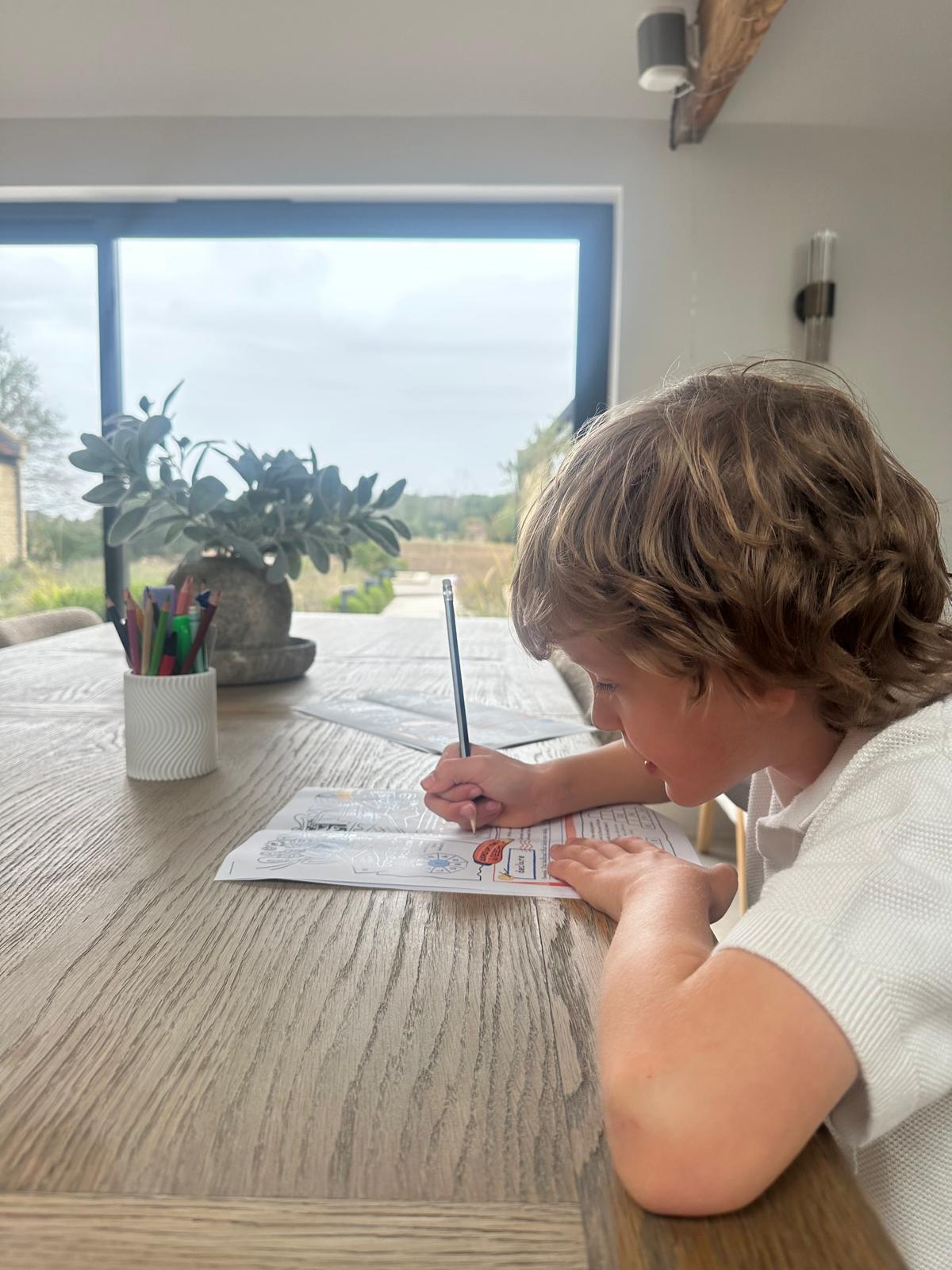
If the words “Have you done your homework?” regularly cause groans in your house, you're certainly not alone.
After more than 15 years working in education — and now as a mum of three — I know that the end of the school day isn't always the easiest time to persuade children to sit down and do more work. They've already spent hours concentrating, listening, writing, calculating and following instructions. By the time they get home, many children quite understandably want to switch off.
But that doesn't mean learning at home has to disappear altogether.
In fact, some of the most valuable learning children do at home may not look very much like homework at all.
Start by taking the pressure off
When a child is reluctant to do homework, our instinct can be to push harder. Sometimes that's necessary — school homework still needs to be done — but when we're thinking more broadly about supporting learning at home, I think it's worth separating learning from formal work.
Children learn when they read a book because they're interested in the story. They learn when they work out how much change they should receive in a shop, discover an unfamiliar word, solve a riddle or argue convincingly about why their answer to a question makes sense.
None of those experiences needs to begin with a worksheet being placed in front of them and an instruction to complete it.
That distinction was one of the reasons I created Friday Brain Building Club. I wanted children to have something worthwhile to do away from a screen, but I didn't want it to feel like another piece of homework.
Make learning feel achievable
There's a big psychological difference between being handed a large workbook and being presented with one intriguing challenge.
If your child is resistant to learning at home, start small.
A riddle over breakfast, a five-minute word game in the car or a single puzzle left on the kitchen table can be enough. The aim isn't to recreate school at home. It's to keep children curious and give them regular opportunities to use their brains.
Small successes matter too. When children solve something they initially found difficult, they experience the satisfaction of having worked it out for themselves. Over time, those experiences can help build confidence and a willingness to tackle something unfamiliar.
Follow their curiosity
Children are much more likely to engage when something captures their interest.
If your child loves football, look at league tables, calculate points and goal differences, read match reports or investigate the geography of the teams.
If they love animals, find out why flamingos are pink, which animals are nocturnal or how a penguin survives in Antarctica.
If they like puzzles, introduce crosswords, Sudoku, code-breaking, riddles or logic problems.
The subject itself matters less than the thinking taking place around it.
Questions such as “Why do you think that?”, “How could we find out?” and “How did you work that out?” can turn an ordinary conversation into an opportunity for reasoning.
Read — and talk about what you read
If you want to do one thing consistently at home, reading remains enormously valuable.
But reading doesn't have to mean sitting silently with a novel for half an hour. Comics, magazines, recipes, instructions, fact books and newspapers written for children all expose them to vocabulary, information and ideas.
Talking matters too.
Ask what an unfamiliar word might mean. Wonder what could happen next. Discuss why a character behaved in a particular way. Make connections with things your child already knows.
You're helping them do far more than simply decode words: they're thinking, interpreting and building knowledge.
Don't be afraid of a little struggle
When children say, “I can't do it,” it can be very tempting to jump in with the answer.
Try giving them a little longer.
You might offer a clue, ask them to explain what they've tried or suggest they approach the problem differently. The aim isn't to leave a frustrated child struggling indefinitely, but neither do we need to remove every difficulty immediately.
Working something out independently can be incredibly satisfying.
Think little and often
Supporting your child's learning at home doesn't require hours of extra work.
Ten enjoyable minutes spent solving a problem, learning a new word or discussing an interesting question can be more valuable than a much longer session that ends in frustration.
That's the approach I favour in my own home, and it's at the heart of Friday Brain Building Club too: small, regular opportunities to think, learn and succeed.
Because ultimately, the goal isn't to create children who willingly complete endless amounts of homework.
It's to create children who are curious enough to keep learning even when nobody has told them to.
Want an easy way to get them thinking?
Friday Brain Building Club gives children aged 7–11 a fresh, screen-free activity sheet every Friday, packed with puzzles and challenges designed to build literacy, numeracy, vocabulary, reasoning and problem-solving skills — without feeling like more homework.
Try Friday Brain Building Club free for 30 days, then from £4.99 per month. Cancel anytime.